

Environmental Monitoring
Drone
Machine Learning
Artificial Intelligence
Soft Robotics
Waste Management
FKZ 02WDG1759
DroneGripper
Automated Gripping and Handling of Objects Using Drones in Environmental Protection
Duration: November 1, 2025 – October 31, 2027
Consortium:
Contact Person (Coordinator)
Prof. Dr.-Ing. Daniel Görges
Rheinland-Pfälzische Technische Universität Kaiserslautern-Landau
Lehrstuhl für Elektromobilität
Erwin-Schrödinger-Straße 12
67663 Kaiserslautern
What the Project Is About
For several years now, drones have been increasingly used in environmental protection, for example to monitor ecosystems. However, their use for detecting, grasping, and moving objects—such as in the cleanup of environmental pollution or the handling of hazardous materials—remains extremely limited. There is considerable potential here, but also technical and scientific challenges due to the complex interaction between the drone and its physical environment. Basic research has yielded initial methods for detecting and grasping objects with drones. For practical application in real-world environments, however, these methods still need to be comprehensively refined, particularly in terms of robustness and adaptability. This is where the DroneGripper project comes in.
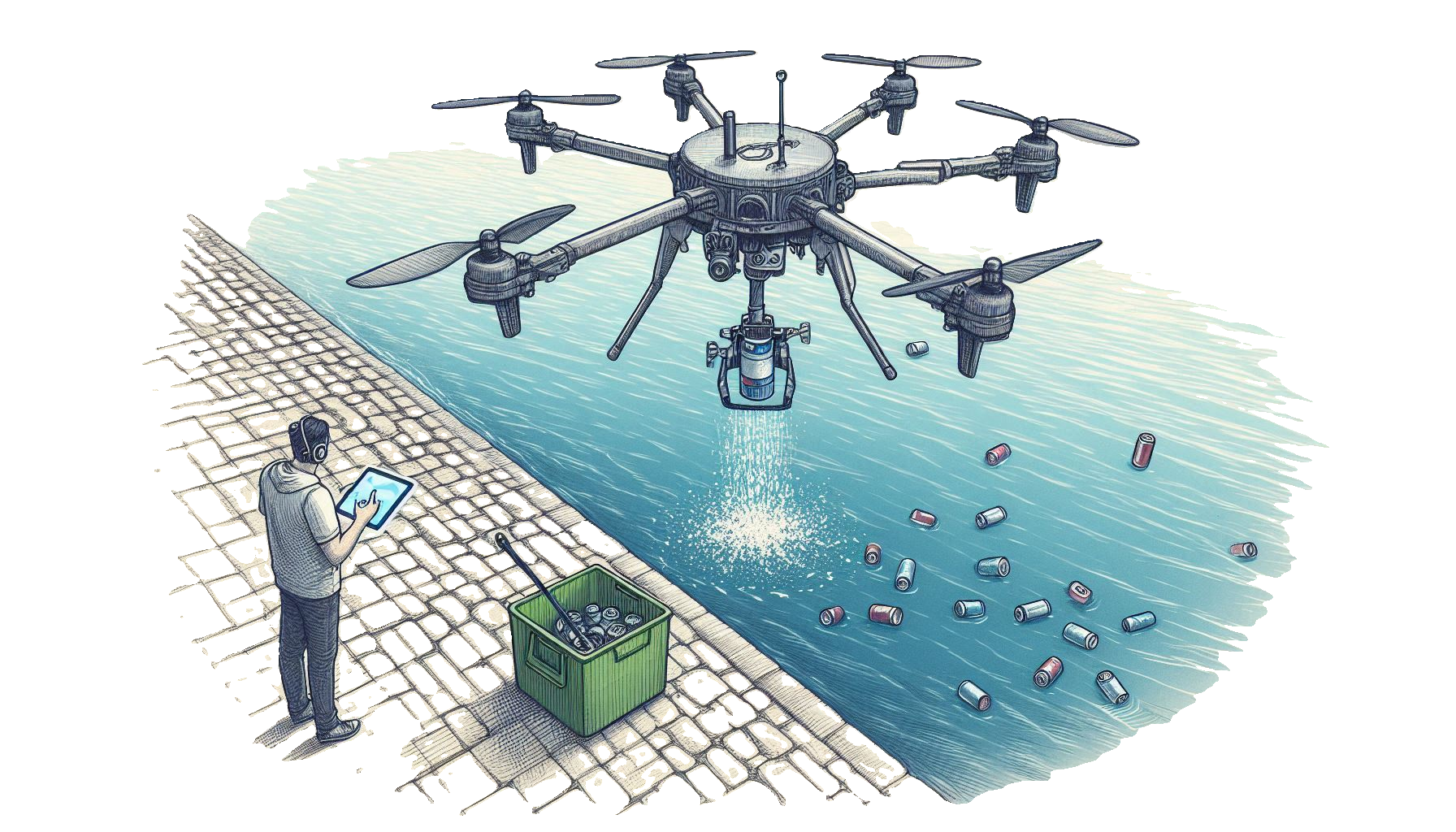
The goal of the project is to design, build, and evaluate a drone equipped with a gripper that can automatically detect, grasp, and move complex objects in environmental protection applications. Concepts from adaptive control and soft robotics are utilized to achieve high robustness and adaptability. These form the innovative core of the project. Particular emphasis is placed on modular hardware and software to accommodate various applications in environmental protection. A specific use case under consideration is the automated collection of waste in hard-to-reach areas. The drone flies over a defined area, detects waste, and collects it after receiving approval from a human supervisor. Experts from the fields of waste management, water protection, road operations, and disaster response are involved in the requirements analysis and practical evaluation of the drone to ensure that real-world experiences and needs are specifically taken into account.