Recycling and the Circular Economy
Robotics
Environmental Impact Assessment
Wind Energy
Fiber-Reinforced Composites
Renewable Energy
FKZ 02WDG1769
RobWind
Robot-Based Material Recovery for Wind Turbine Rotor Blades
Duration: November 1, 2025 – October 31, 2027
Consortium:
- cp.max Rotortechnik GmbH Co.KG
- Fraunhofer Institute for Wind Energy Systems (IWES) – Bremerhaven
- Fraunhofer Institute for Large Structures in Production Engineering IGP
- Hanseatic Rohr GmbH
Contact Person (Coordinator)
Dip.-Ing. Thomas Heinecke, M.Sc.
cp.max GmbH & Co. KG
Manfred-von-Ardenne-Ring 5
01099 Dresden
What the Project Is About
Project Objective
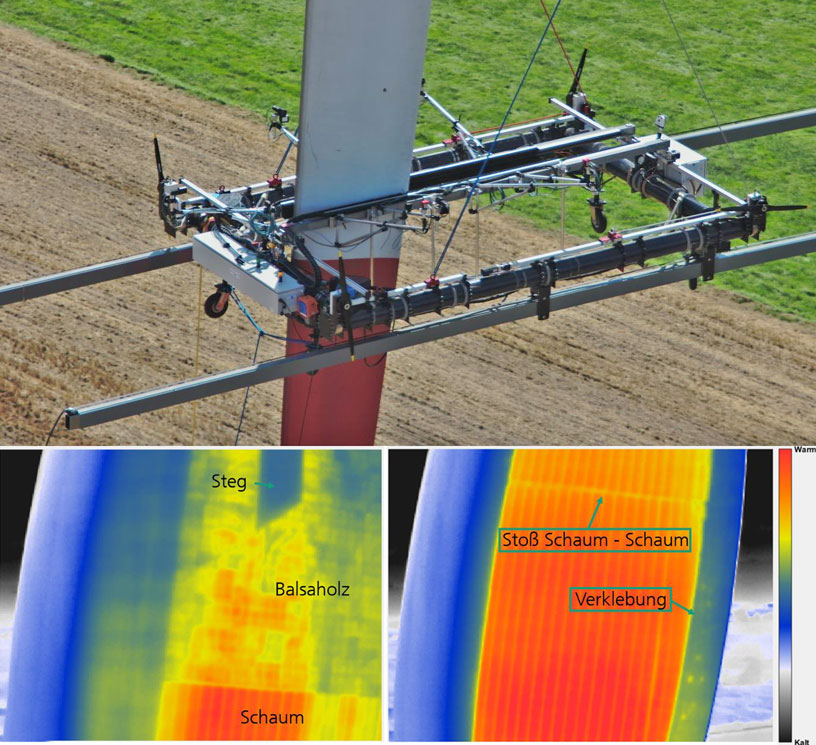
To enable targeted recycling of the various materials in the rotor blade, it is necessary to precisely identify their locations within the blade shells. This task will be addressed using a semi-automated inspection platform. Using thermal imaging cameras, the platform visualizes the interior of the blade shells and creates a digital map of the materials incorporated into the blade.
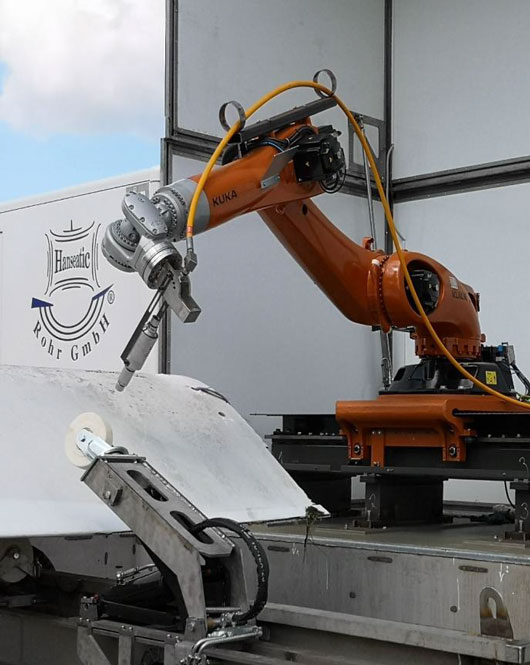
With this information, a waterjet cutting robot can then automatically separate areas containing different blade materials from one another. Since the robot is mobile, this disassembly can take place directly at the base of the wind turbine. This also significantly facilitates the transport of the blades, as the blade is now divided into segments measuring just a few meters in length. In contrast, a modern rotor blade is often over 70 meters long, making transportation a challenging and costly undertaking.
Background
However, the recycling of rotor blades has not yet been sufficiently developed. This is because a wide variety of materials are encased in a plastic matrix within the rotor blade. This plastic, a thermoset, cannot be melted to easily separate the materials.
Consequently, rotor blades have so far only been able to be cut into smaller segments, shredded, and then thermally recycled. However, due to the rapidly growing volume of end-of-life rotor blades in the medium and long term, this type of recycling cannot be continued indefinitely. Furthermore, there are certain blade components that must be removed before shredding.
For example, modern rotor blades often contain individual sections made of carbon fibers. These cannot be recycled using conventional methods. They are also a valuable material, which is why separate recycling makes financial sense as well.
Projektgalerie
-
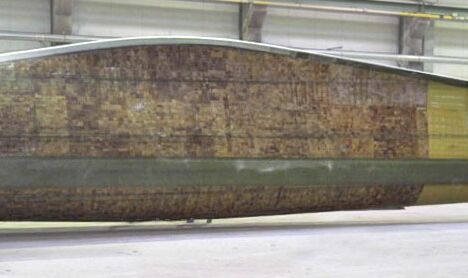
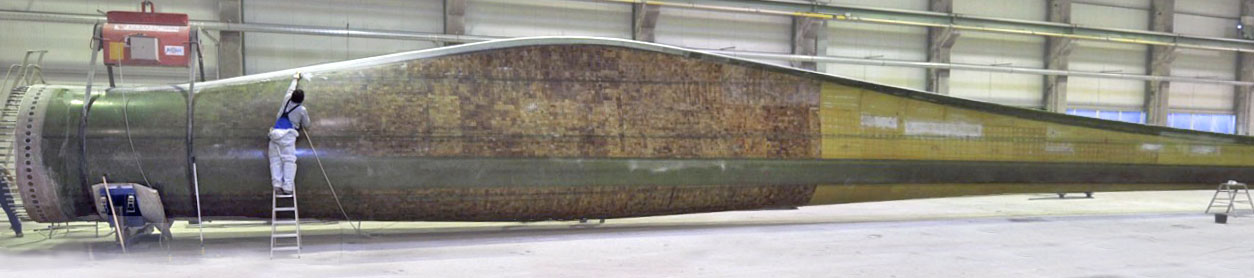
Bei einem unlackierten Rotorblatt sind deutlich große Bereiche mit unterschiedlichen Materialaufbau erkennbar. -
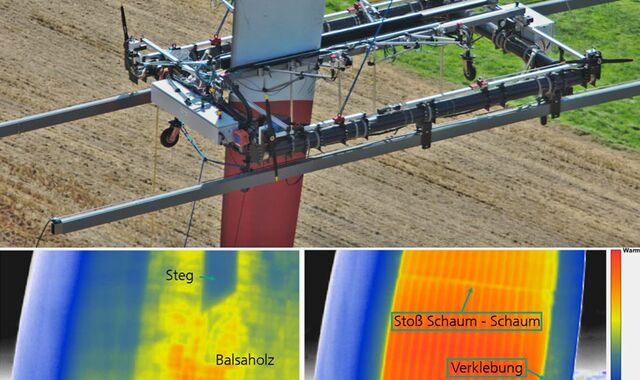
An Seilen wird eine Messplattform am Rotorblatt abgelassen. Ihre Wärmebildkameras machen die innere Struktur des Blattes sichtbar -
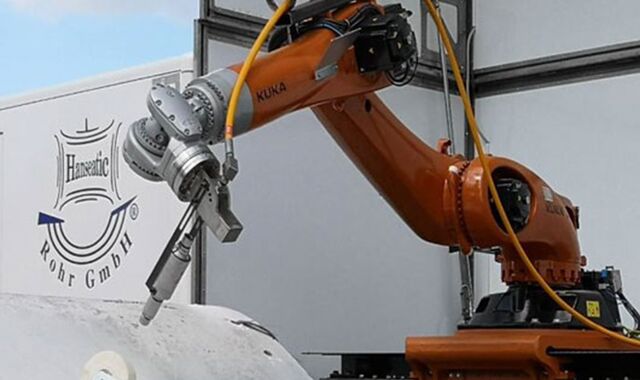
A robot equipped with a waterjet cutter can precisely cut sections of the rotor blade made of different materials.