

Wind Energy: Robot System and AI Aim to Detect Damage in Rotor Blades Earlier
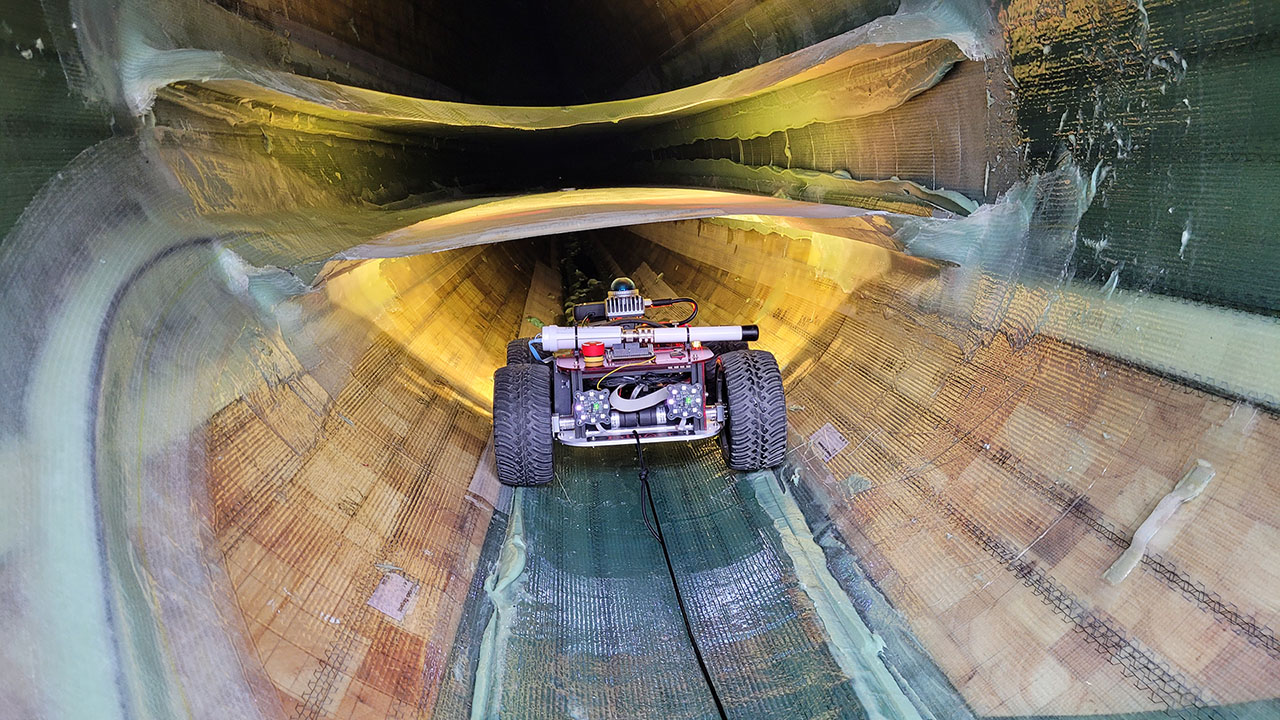 Internal inspection of rotor blades
Wind turbine rotor blades are getting larger and larger, making them increasingly difficult to inspect. As part of the InInspekt collaborative project, the Federal Institute for Materials Research and Testing (BAM) is working with other project partners to develop an autonomous robotic system that detects damage at an early stage—long before it becomes critical.
Berlin, 24.03.2026
Wind turbine rotor blades are getting larger and larger, making them increasingly difficult to inspect. As part of the InInspekt collaborative project, the Federal Institute for Materials Research and Testing (BAM) is working with other project partners to develop an autonomous robotic system that detects damage early on—long before it becomes critical.
Offshore blades now reach lengths of over 100 meters, towering over multi-story buildings. This, however, makes conventional inspections more difficult. Furthermore, much of the damage occurs deep within the complex fiber-reinforced structures and is invisible to conventional inspection methods. But once a defect has reached the surface, repairs are often time-consuming and costly—or even require replacing the entire rotor blade. Furthermore, manual inspections inside the narrow interior of a rotor blade, which must be locked in a vertical position for this purpose, are extremely labor-intensive and not without risks for personnel.
For this reason, the joint project—involving BAM, the Julius Maximilian University of Würzburg, EduArt Robotik GmbH, and the Marburg-based AI specialist LATODA—aims to fundamentally modernize the inspection of rotor blades.
“We are relying on a mobile and largely autonomous robotic system that can detect internal damage earlier and at a lower cost than before,” explains BAM expert Michael Stamm from the Wind@BAM Competence Center. The system complements a method for the external inspection of rotor blades using ground-based thermal imaging cameras, which BAM is developing in collaboration with industry.
At the heart of InInspect is a mobile robot designed to perform on-site inspections and optimized for use in the hard-to-reach interior spaces of the blades. It is equipped with a combination of highly advanced sensors:
- A laser-based measurement and remote sensing system (LiDAR) serves—similar to autonomous driving—to provide precise orientation inside the blade and enables millimeter-precise measurement of the structures. This allows damage to be precisely localized and documented for later risk analyses.
- High-resolution cameras provide visual data on visible surface and near-surface defects.
- Thermography additionally makes the interior visible: The robot independently heats the fiber-reinforced structures using a heat source, allowing even previously hidden, deep-seated damage to be classified.
The complex sensor data is analyzed using AI-powered image recognition technology developed specifically for this purpose. It automatically identifies anomalies, classifies damage, and presents the findings clearly. This enables operating companies to make timely decisions. “The system delivers consistent measurement quality over many years, providing the basis for precise predictions regarding a plant’s service life and the optimal timing for the next maintenance,” says Michael Stamm.
The research project is funded by the Federal Ministry of Research, Technology, and Space (BMFTR) as part of the “Digital Green Tech – Environmental Technology Meets Robotics” initiative.
At the Hannover Messe from April 20–24, 2026, the Wind@BAM Competence Center will present smart solutions for maximizing the performance and operational lifespan of wind turbines, including methods for efficient rotor blade inspection. Visit the BAM team at the BMWE booth in Hall 11/B49.
On March 31, 2026, the Wind@BAM Competence Center will host the technical colloquium “Service Life and Condition Assessment of Support Structures for Onshore Wind Turbines.”
Contact
Oliver Perzborn
Leiter Kommunikation, Marketing
Tel: 030-8104-1013
E-Mail: oliver.perzborn@bam.de
The Federal Institute for Materials Research and Testing (BAM) is a federal scientific and technical authority under the jurisdiction of the Federal Ministry for Economic Affairs and Energy. It conducts testing, research, and provides consulting services to protect people, the environment, and property. The BAM sets and upholds high standards for safety in technology and chemistry for Germany and its global markets, with the aim of further developing the successful German quality culture known as “Made in Germany.” The BAM fulfills this mission with the help of approximately 1,550 people from 55 nations.